
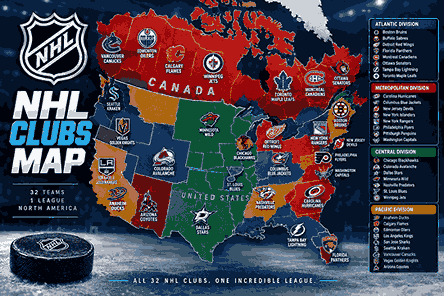
You want to know where every NHL team plays, but scattered websites make it frustrating. Without a reliable NHL clubs map, tracking divisions, conferences, and cross-border rivalries feels overwhelming. This complete guide lays out every franchise location, home arena, and geographic grouping so you gain total clarity on league geography in minutes.
What Is the NHL Clubs Map and Why Does It Matter?
The NHL clubs map is a geographic layout of all 32 professional hockey franchises across the United States and Canada. It organizes teams by conference and division, giving fans a clear picture of where each club calls home.
Hockey geography directly affects travel schedules, playoff matchups, and natural rivalries. Understanding the NHL clubs map helps you follow the league with greater context, whether you watch every game or check scores once a week.
The National Hockey League expanded to 32 teams after the Seattle Kraken joined in 2021, according to NHL.com. This growth reshaped the geographic balance between conferences and created fresh storylines for fans everywhere.
Table of Contents
How Does the NHL Divide Teams Across Two Conferences?
The league splits its 32 franchises into the Eastern Conference and the Western Conference. Each conference contains 16 teams and two four-team divisions.
The Eastern Conference houses the Atlantic Division and the Metropolitan Division. The Western Conference holds the Central Division and the Pacific Division.
This structure keeps travel manageable and ensures playoff brackets reward geographic proximity. Teams within the same division play each other more often during the regular season, which fuels intense local rivalries.
Which Teams Appear on the Eastern Conference NHL Clubs Map?
The Eastern Conference stretches from Montreal to Sunrise, Florida. It covers the most densely populated hockey markets in North America.
The Eastern Conference consistently produces high-scoring games and fierce playoff series. Its geographic footprint spans three countries’ worth of time zones if you count the Canadian clubs.
Atlantic Division: Where Are These Teams Located?
The Atlantic Division features eight teams rooted in the Northeast United States and Eastern Canada. These clubs represent some of the oldest and most storied franchises in hockey.
- Boston Bruins — Boston, Massachusetts (TD Garden)
- Buffalo Sabres — Buffalo, New York (KeyBank Center)
- Detroit Red Wings—Little Caesars Arena, Detroit, Michigan
- Florida Panthers at Amerant Bank Arena in Sunrise, Florida
- Montreal Canadiens — Montreal, Quebec (Bell Centre)
- Ottawa Senators — Ottawa, Ontario (Canadian Tire Centre)
- Tampa Bay Lightning: Amalie Arena, Tampa, Florida
- Toronto Maple Leafs — Toronto, Ontario (Scotiabank Arena)
This division packs historic Canadian hockey cities together with warm-weather Florida teams. The contrast creates one of the most geographically diverse groupings on the NHL clubs map.
Metropolitan Division: What Makes This Region So Competitive?
The Metropolitan Division clusters eight teams along the Eastern Seaboard and into Pennsylvania. This region produces some of the league’s most physical and tightly contested games.
- Carolina Hurricanes—PNC Arena in Raleigh, North Carolina
- Columbus Blue Jackets at Nationwide Arena in Columbus, Ohio
- New Jersey Devils — Newark, New Jersey (Prudential Center)
- Elmont, New York (UBS Arena): New York Islanders
- New York Rangers — New York City, New York (Madison Square Garden)
- Philadelphia Fliers: Wells Fargo Center, Philadelphia, Pennsylvania
- Pittsburgh Penguins: PPG Paints Arena, Pittsburgh, Pennsylvania
- Washington Capitals — Washington, D.C. (Capital One Arena)
Three Pennsylvania and New York-area rivalries dominate this division. The proximity between these arenas means fans frequently travel to away games, turning every matchup into a hostile environment.
How Does the Western Conference Look on the NHL Clubs Map?
The Western Conference covers a massive geographic area from Winnipeg to Anaheim. Teams in this conference log the most travel miles each season.
Sixteen franchises split between the Central and Pacific Divisions make up the Western side of the NHL clubs map. The sheer distance between cities like Vancouver and Dallas shapes scheduling decisions and player fatigue throughout the year.
Data from Hockey-Reference.com confirms Western Conference teams historically face longer road trips than their Eastern counterparts. This geographic reality influences roster depth strategies and back-to-back game performance.
Central Division: Which Cities Anchor This Group?
The Central Division spans the North American heartland from the Canadian Prairies to the American South. It blends traditional hockey markets with non-traditional ones.
- Chicago Blackhawks — Chicago, Illinois (United Center)
- Colorado Avalanche — Denver, Colorado (Ball Arena)
- Dallas Stars — Dallas, Texas (American Airlines Center)
- Minnesota Wild—Xcel Energy Center, Saint Paul, Minnesota
- Nashville Predators — Nashville, Tennessee (Bridgestone Arena)
- St. Louis Blues — St. Louis, Missouri (Enterprise Center)
- Utah Hockey Club — Salt Lake City, Utah (Delta Center)
- Winnipeg Jets—Canada Life Center, Winnipeg, Manitoba
The addition of the Utah Hockey Club in 2024 shifted the Central Division’s western boundary. This move brought NHL hockey to a new mountain market and realigned travel patterns across the conference.
Pacific Division: Where Do West Coast and Desert Teams Play?
The Pacific Division stretches along the western edge of the continent. It includes Canadian West Coast cities, California markets, and desert franchises.
- Anaheim Ducks — Anaheim, California (Honda Center)
- Calgary Flames — Calgary, Alberta (Scotiabank Saddledome)
- Edmonton Oilers — Edmonton, Alberta (Rogers Place)
- Los Angeles Kings — Los Angeles, California (Crypto.com Arena)
- San Jose Sharks — San Jose, California (SAP Center)
- Seattle Kraken at Climate Pledge Arena in Seattle, Washington
- Vancouver Canucks — Vancouver, British Columbia (Rogers Arena)
- Vegas Golden Knights — Las Vegas, Nevada (T-Mobile Arena)
The Battle of Alberta between Calgary and Edmonton stands as one of hockey’s fiercest geographic rivalries. Meanwhile, the Vegas Golden Knights proved that desert hockey thrives when a franchise connects with its local community.
Complete NHL Clubs Map Table: All 32 Franchises at a Glance
The table below organizes every active NHL franchise by conference, division, city, and home arena. Use it as a quick reference alongside any NHL clubs map you consult.
| Conference | Division | Team | City | Home Arena |
| Eastern | Atlantic | Boston Bruins | Boston, MA | TD Garden |
| Eastern | Atlantic | Buffalo Sabres | Buffalo, NY | KeyBank Center |
| Eastern | Atlantic | Detroit Red Wings | Detroit, MI | Little Caesars Arena |
| Eastern | Atlantic | Florida Panthers | Sunrise, FL | Amerant Bank Arena |
| Eastern | Atlantic | Montreal Canadiens | Montreal, QC | Bell Centre |
| Eastern | Atlantic | Ottawa Senators | Ottawa, ON | Canadian Tire Centre |
| Eastern | Atlantic | Tampa Bay Lightning | Tampa, FL | Amalie Arena |
| Eastern | Atlantic | Toronto Maple Leafs | Toronto, ON | Scotiabank Arena |
| Eastern | Metropolitan | Carolina Hurricanes | Raleigh, NC | PNC Arena |
| Eastern | Metropolitan | Columbus Blue Jackets | Columbus, OH | Nationwide Arena |
| Eastern | Metropolitan | New Jersey Devils | Newark, NJ | Prudential Center |
| Eastern | Metropolitan | New York Islanders | Elmont, NY | UBS Arena |
| Eastern | Metropolitan | New York Rangers | New York City, NY | Madison Square Garden |
| Eastern | Metropolitan | Philadelphia Flyers | Philadelphia, PA | Wells Fargo Center |
| Eastern | Metropolitan | Pittsburgh Penguins | Pittsburgh, PA | PPG Paints Arena |
| Eastern | Metropolitan | Washington Capitals | Washington, D.C. | Capital One Arena |
| Western | Central | Chicago Blackhawks | Chicago, IL | United Center |
| Western | Central | Colorado Avalanche | Denver, CO | Ball Arena |
| Western | Central | Dallas Stars | Dallas, TX | American Airlines Center |
| Western | Central | Minnesota Wild | Saint Paul, MN | Xcel Energy Center |
| Western | Central | Nashville Predators | Nashville, TN | Bridgestone Arena |
| Western | Central | St. Louis Blues | St. Louis, MO | Enterprise Center |
| Western | Central | Utah Hockey Club | Salt Lake City, UT | Delta Center |
| Western | Central | Winnipeg Jets | Winnipeg, MB | Canada Life Centre |
| Western | Pacific | Anaheim Ducks | Anaheim, CA | Honda Center |
| Western | Pacific | Calgary Flames | Calgary, AB | Scotiabank Saddledome |
| Western | Pacific | Edmonton Oilers | Edmonton, AB | Rogers Place |
| Western | Pacific | Los Angeles Kings | Los Angeles, CA | Crypto.com Arena |
| Western | Pacific | San Jose Sharks | San Jose, CA | SAP Center |
| Western | Pacific | Seattle Kraken | Seattle, WA | Climate Pledge Arena |
| Western | Pacific | Vancouver Canucks | Vancouver, BC | Rogers Arena |
| Western | Pacific | Vegas Golden Knights | Las Vegas, NV | T-Mobile Arena |
How Does Geography Shape NHL Rivalries?
Proximity breeds competition. Teams that sit close together on the NHL clubs map naturally develop heated rivalries because fans interact constantly and travel easily to opposing arenas.
Consider the Penguins and Flyers, separated by just 300 miles across Pennsylvania. Or the Canadiens and Bruins, whose Original Six rivalry spans over a century of playoff battles.
Geographic rivalries also extend across borders. The Vancouver Canucks and Calgary Flames fuel a passionate British Columbia versus Alberta clash that divides Western Canada every season.
Which New Franchises Changed the NHL Clubs Map Recently?
The NHL clubs map has shifted twice in the last decade. The Vegas Golden Knights joined the Pacific Division in 2017 as the league’s 31st team.
The Seattle Kraken followed in 2021, giving the Pacific Northwest its first NHL franchise. According to ESPN’s NHL coverage, the Kraken’s arrival balanced the conferences at 16 teams each.
The most recent change came in 2024 when the Arizona Coyotes relocated to Salt Lake City, becoming the Utah Hockey Club. This move planted an NHL flag in the Mountain West for the first time.
How Can You Use the NHL Clubs Map for Travel and Fandom?
Planning a hockey road trip starts with studying the NHL clubs map. Cluster nearby arenas together to maximize the number of games you attend in a single trip.
The Northeast corridor offers the densest concentration of NHL venues. You can catch games in Boston, New York, Newark, Philadelphia, and Pittsburgh within a single week by car or train.
On the West Coast, a Vancouver-to-Los Angeles route lets you visit five Pacific Division arenas. Pair each stop with local food and culture to turn your hockey trip into a full vacation.
Frequently Asked Questions About the NHL Clubs Map
How many teams are on the NHL clubs map?
The NHL clubs map features 32 active franchises split evenly between the Eastern and Western Conferences.
Which NHL team is the farthest north?
The Edmonton Oilers sit at the northernmost point on the NHL clubs map, located in Alberta, Canada.
Which NHL team is the farthest south?
The Florida Panthers hold the southernmost position, playing in Sunrise, Florida, just outside Miami.
Has the NHL clubs map changed recently?
Yes. The Utah Hockey Club replaced the Arizona Coyotes in 2024, shifting the Central Division’s footprint westward.
How many Canadian teams appear on the NHL clubs map?
Seven Canadian franchises appear on the map: Montreal, Toronto, Ottawa, Winnipeg, Calgary, Edmonton, and Vancouver.
Which division covers the largest geographic area?
The Pacific Division spans the greatest distance, stretching from Vancouver, British Columbia, to Anaheim, California
Pingback: NHL Games Tonight: Complete Schedule, Live Streams, Scores & Everything You Need u7