
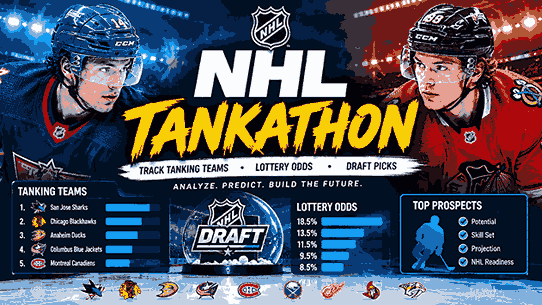
Losing feels bad. Losing on purpose feels strategic, and that’s the tension NHL Tankathon exists to track. Every fall, bottom-table fans stop watching the standings for wins and start watching them for draft position instead. If you’ve landed on Tankathon.com and found yourself staring at percentages, ping-pong-ball combinations, and prospect grids with no idea what any of it means, this guide translates the whole page in plain language.
Quick Answer
NHL Tankathon is a free sports-data website that tracks the NHL draft order, calculates each team’s draft lottery odds in real time, and runs mock drafts based on current prospect rankings. It updates automatically after every game, so the numbers you see reflect the standings as they stood last night, not last week.
Table of Contents
What Is NHL Tankathon?
NHL Tankathon is a specialized tracking tool built for one audience: fans of teams that are, realistically, not making the playoffs. Instead of ignoring a rough season, the site reframes it. It converts the standings into projected draft position, live lottery odds, and a running mock draft that updates as prospects play.
The platform covers five major leagues, and its NHL section is one of the most visited pages during any rebuild. Fans use it to answer one question: if the season ended today, what pick would my team hold, and who might they take with it?
The tool didn’t invent this fan behavior. People have tracked “tanking” informally for decades. What the site added was structure — real odds, updated automatically, tied to actual prospect data instead of guesswork.
How NHL Tankathon Tracks the Draft Order
The draft order page is the foundation of the entire site. It pulls current standings and converts them into a projected first-round order, updating after every game played across the league.
Here’s what shapes that order:
- Points percentage, not raw points, since teams play a different number of games at any given moment
- Regulation wins (RW) and regulation/non-shootout overtime wins (ROW), used as tiebreakers
- Trade-acquired picks, tracked separately so a pick’s true owner is always visible
- Conditional picks, flagged when a trade includes protections tied to final standing
Because the order updates automatically, checking the site after a Tuesday night slate of games can look noticeably different from Monday morning. That responsiveness is the main reason fans keep it bookmarked through the second half of the season.
How NHL Draft Lottery Odds Actually Work
This is the part most visitors misread, so it deserves a careful walkthrough. Only non-playoff teams enter the NHL Draft Lottery, and the worst regular-season record earns the best odds — but not a guarantee.
The league runs the lottery in two draws:
- First draw: determines the No. 1 overall pick. Any of the bottom-16 teams can win, but a team can only move up a maximum of ten spots from where it finished. That rule limits the realistic No. 1 contenders to the bottom 11 clubs.
- Second draw: determines the No. 2 overall pick, using the re-seeded order left after the first draw.
According to the NHL’s official lottery guide, the last-place team typically holds roughly an 18.5% chance at the first pick, not a lock, and the odds decline from there through the field of contenders. NHL Tankathon mirrors this exact structure, so its percentages match the league’s own published combinations rather than an independent estimate.
A team can only improve its draft position through the lottery twice in any five-year window, a rule the league added in 2022 to discourage repeated deep tanking. The site flags teams that have already used a lottery jump, which matters when you’re projecting a rebuild multiple years out.
NHL Draft Lottery Odds Table (Current Structure)
| Standings Position (Worst to Best) | Odds for 1st Overall | Odds for 2nd Overall | Eligible for No. 1 Pick? |
| 1st (fewest points) | ~18.5% | Reseeded after draw 1 | Yes |
| 2nd | ~13.5% | Reseeded after draw 1 | Yes |
| 3rd | ~11.5% | Reseeded after draw 1 | Yes |
| 4th | ~9.5% | Reseeded after draw 1 | Yes |
| 5th | ~8.5% | Reseeded after draw 1 | Yes |
| 6th | ~7.5% | Reseeded after draw 1 | Yes |
| 7th | ~6.5% | Reseeded after draw 1 | Yes |
| 8th–11th | 6.0%–3.0% | Reseeded after draw 1 | Yes |
| 12th–16th | 0% | Can win draw 1, capped at 10-spot jump | No |
Odds are illustrative of the standard NHL lottery weighting and shift slightly each season based on final standings. Always check Tankathon.com or NHL.com directly for the live figures tied to the current draft class.
NHL Tankathon Mock Draft: How the Board Comes Together
The mock draft is the feature casual visitors open first. It pairs the projected draft order with a ranked prospect board, then slots each player to the team currently holding that pick.
A few details make this section more useful than a generic prospect list:
- It reorders automatically as the draft order shifts, so a mock draft in October looks different by March
- It includes stat lines for each prospect — goals, assists, points, and games played in their actual junior, college, or European league
- It calculates NHLe (NHL Equivalency), a translation factor that estimates what a prospect’s point production might look like over an 82-game NHL season, based on the scoring strength of their current league
None of this is a guarantee of who a team will actually draft. It’s a projection built from public rankings and current standings, useful for framing conversations rather than predicting outcomes with certainty.
Reading NHL Tankathon’s Big Board and Prospect Rankings
Separate from the mock draft, the Big Board ranks prospects purely on talent, independent of which team might pick them. This distinction trips people up constantly.
- The mock draft answers: “Who will this team likely take at this slot?”
- The Big Board answers: “Who is the best prospect available, regardless of team need?”
A player can rank third on the Big Board but slide to eighth in the mock draft simply because the projection accounts for team fit, positional need, or organizational depth. Reading both together gives a far more complete picture than either alone.
Key Stats NHL Tankathon Uses (NHLe, ROW, RW Explained)
The abbreviations scattered across the site aren’t decoration. Each one carries a specific meaning:
- NHLe (NHL Equivalency): a formula estimating a prospect’s projected NHL point production, calculated as points-per-game multiplied by a league translation factor, then scaled to an 82-game season
- ROW (Regulation + Overtime Wins): wins that didn’t require a shootout, used as a tiebreaker in standings and lottery seeding
- RW (Regulation Wins): wins earned in regulation time only, the first tiebreaker applied
- Points percentage: total points earned divided by total possible points, which levels the comparison between teams that have played different numbers of games
Once these terms click, the rest of the site reads far more clearly.
Why Fans Call It “Tanking” and How Tankathon Fits In
“Tanking” describes a front office prioritizing long-term asset accumulation over short-term wins, usually late in a lost season. Teams rarely admit to it outright, but roster moves — resting veterans, promoting prospects, trading rentals — often signal the intent.
Tankathon didn’t create this strategy; it simply made the strategy visible and trackable in real time. Before tools like this existed, fans estimated draft position from memory and rough math. Now the calculation happens automatically, game by game, which is a large part of why the tool built such a loyal following among rebuilding fan bases.
NHL Tankathon vs. Other Draft Tracking Tools
Several outlets publish draft projections, but they differ in scope and update speed.
| Feature | NHL Tankathon | League Official Guide | General Sports Media |
| Updates after every game | Yes | No (season snapshots) | Rarely |
| Live mock draft with stats | Yes | No | Sometimes |
| Covers 5 major leagues | Yes | No (single league) | No |
| Free lottery simulator | Yes | No | No |
| Official league data source | No | Yes | No |
Its advantage is speed and interactivity. For the legally binding odds and rules, the league’s own published guide remains the authoritative record — this tool simply builds its calculations to match it.
How to Use NHL Tankathon to Follow Your Team
Getting real value from the site takes more than glancing at a percentage once. Try this approach instead:
- Bookmark your team’s projected pick position, then revisit it weekly rather than daily to avoid overreacting to a single game
- Cross-check the mock draft against the Big Board to see whether “team need” is pushing a prospect up or down
- Watch the lottery odds table, not just the draft order, since the two tell different stories once several teams cluster near the bottom
- Note any conditional or traded picks tied to your team, since those change hands based on performance thresholds
Common Mistakes People Make Reading Tankathon Odds
A few misunderstandings show up constantly in comment sections and fan forums:
- Assuming the worst record locks in the No. 1 pick. It only improves the odds; the ping-pong balls decide the rest.
- Ignoring the ten-spot cap. A team ranked 14th cannot leap to first overall, no matter what the lottery draw produces.
- Treating the mock draft as a prediction. It’s a projection based on public rankings, not inside information from any team’s actual draft room.
- Forgetting the two-jump limit. A team that has already benefited from lottery luck twice in five years can’t jump again, even with a terrible record.
Historical Draft Lottery Surprises Worth Knowing
The lottery has flipped outcomes often enough that “worst record wins” is far from a safe assumption. The New York Rangers held roughly a 9.5% chance in 2020 and still won, selecting Alexis Lafrenière first overall. More recently, a team seeded tenth in the odds table has jumped all the way to the top pick, a reminder that single-digit percentages still hit.
That unpredictability is exactly why fans keep returning to the site through the spring. The projected order narrows the possibilities; it never eliminates the drama.
Frequently Asked Questions
What is NHL Tankathon used for?
NHL Tankathon tracks the projected NHL draft order, calculates live draft lottery odds, and runs a mock draft based on current prospect rankings, updating after every game.
Is NHL Tankathon accurate?
Its draft order and lottery odds are calculated to match the NHL’s official published lottery structure, so the percentages align closely with the league’s own numbers. Mock draft picks are projections, not confirmed selections.
How often does the site update draft odds?
The site updates automatically after every game played across the league, so odds and draft order can shift daily during the season.
Can a team with the worst record still miss the No. 1 pick?
Yes. The worst record earns the best odds, not a guarantee. The actual pick is decided by a ping-pong-ball drawing, and any of the bottom-11 teams can win it.
What does NHLe mean on the site?
NHLe stands for NHL Equivalency, a formula that estimates a prospect’s projected NHL point production by translating their current league scoring rate to an 82-game NHL season.
Is NHL Tankathon affiliated with the NHL?
No. It is an independent, unofficial site. It models its odds on the league’s published lottery rules but is not run or endorsed by the NHL.
Conclusion
A rebuilding season stops feeling pointless the moment you know what’s actually at stake pick by pick. NHL Tankathon turns a string of tough losses into a live, trackable storyline — one that updates every night and rewards the fans willing to pay attention. Open the site, find your team’s current position, and check back after the next game. The order will move. That’s the entire point
Pingback: NHL Trade Tracker 2025: A Comprehensive Guide to All Deals, Rumors, and Deadline Information